



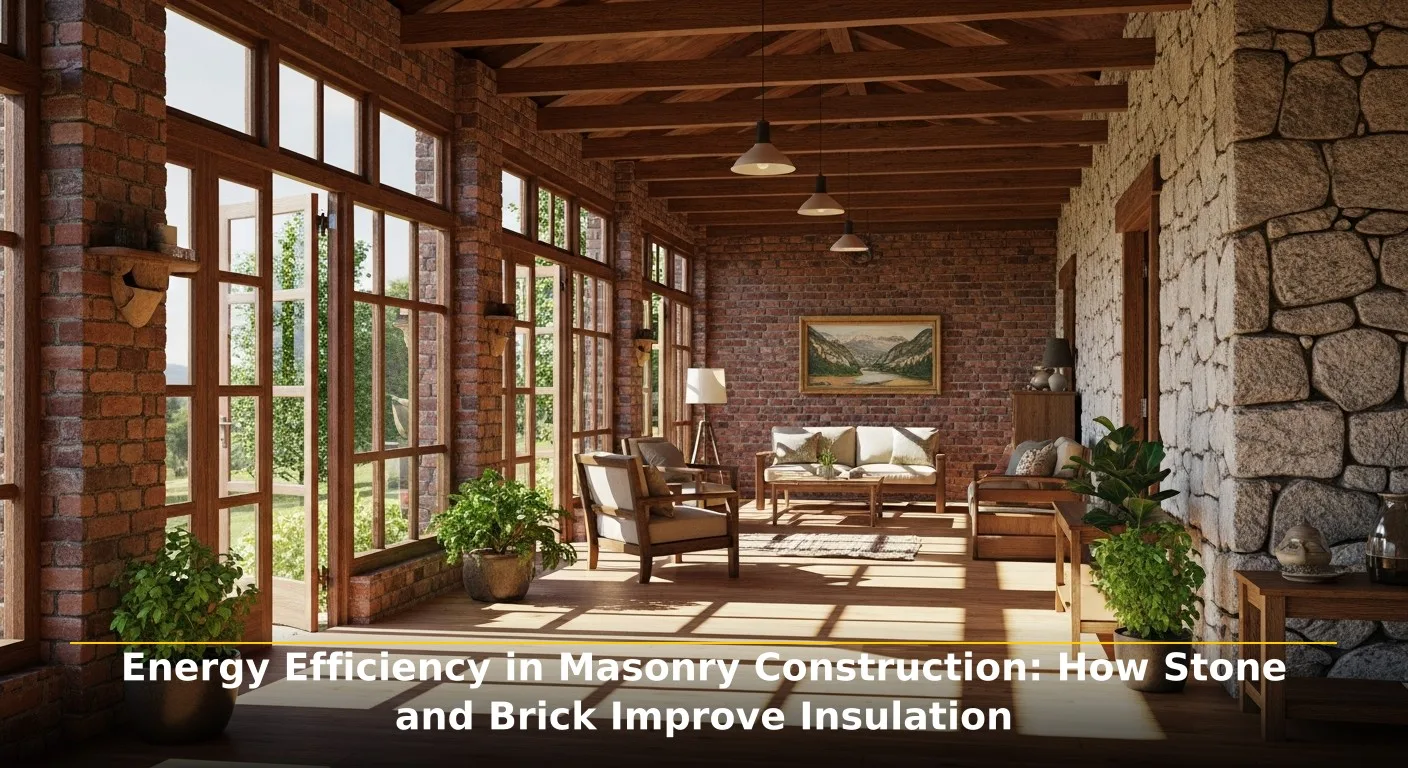
In an era of rising energy costs and growing environmental awareness, Minnesota homeowners and builders are seeking construction methods offering superior comfort and long-term savings. While high-tech solutions often dominate the conversation, one of the most effective energy-efficient technologies is also one of the oldest: masonry.
Stone and brick do not only provide a durable facade; they create dynamic, high-performance building envelopes actively regulating indoor temperatures. This article explores the science behind masonry’s efficiency, offering a clear comparison to conventional construction and outlining best practices for maximizing its benefits in our demanding climate.
1. The Hidden Power of Thermal Mass: Beyond R-Value

When most people think of insulation, what comes to mind is R-value—a measure of resistance to heat flow. While crucial, R-value is a static metric not accounting for the dynamic behavior of heat. This is where masonry’s secret weapon, thermal mass, comes into play.
A. What is Thermal Mass?
Thermal mass is the ability of a material to absorb, store, and later radiate heat energy. Dense materials including brick, stone, and concrete have high thermal mass. Think of a massive stone fireplace that stays warm long after the fire has gone out; your entire masonry wall system operates on the same principle.
B. How Thermal Mass Works in a Minnesota Home
The “thermal flywheel” effect smooths out daily temperature swings, maintaining a more consistent and comfortable indoor environment with less energy consumption from mechanical systems.
- Winter: During the day, sunlight and heat from your HVAC system are absorbed by interior masonry walls. At night, as the air temperature drops, stored heat is slowly released back into the room, reducing the load on your heating system and preventing cold drafts.
- Summer: During the day, the masonry walls absorb heat from the warm indoor air, keeping the living space cooler. At night, stored heat can be vented out with cool night air, recharging the thermal mass for the next day.
2. Masonry vs. Wood-Frame: A Side-by-Side Efficiency Comparison

While a wood-frame wall may have a similar nominal R-value, its real-world performance differs significantly from a masonry wall.
A. The Insulation vs. Mass Misconception
Light-weight wood framing possesses little thermal mass while reacting quickly to temperature changes. They rely almost entirely on cavity insulation. Masonry, by contrast, combines inherent R-value with the stabilizing effect of thermal mass.
B. The Critical Role of Air Infiltration
The #1 cause of energy loss in buildings is unwanted air leakage. Standard wood-frame walls contain countless seams and joints that can leak air. A masonry wall is far more airtight. When combined with modern air barrier systems, masonry construction can achieve exceptional air tightness, drastically reducing energy loss from drafts.
Performance Factor | Standard Wood-Frame Wall | Mass Wall with Continuous Insulation |
Thermal Insulation | Cavity-only (e.g., R-13 to R-21) | Continuous exterior insulation (e.g., R-10 to R-15) + Mass Wall |
Thermal Mass | Very Low | Very High |
Air Tightness | Highly dependent on quality of sealing | Inherently high; easily detailed for superior performance |
Durability | Susceptible to moisture, pests, and rot | Highly resistant to moisture, fire, and pests |
Lifespan | 50-100 years with significant maintenance | 100+ years with minimal maintenance |
3. Building a High-Performance Masonry Envelope: Best Practices for Minnesota

To fully harness the energy-saving potential of masonry, it must integrate into a whole-wall system designed for our specific climate.
A. The Modern Wall Assembly: Mass + Insulation
The most effective strategy is to place continuous insulation on the exterior of the masonry wall. This “Mass-Insulation-Mass” principle solves several problems:
- Protects the Thermal Mass: Keeping the masonry on the interior (warm) side of the insulation allows the wall to absorb and release indoor heat, maximizing thermal flywheel effect.
- Eliminates Thermal Bridging: Continuous insulation wraps the entire structure, preventing heat from escaping through structural components.
- Protects the Masonry: Their insulation layer reduces the number of freeze-thaw cycles the masonry experiences, extending its lifespan.
B. Air and Vapor Barriers: Sealing the Envelope
A continuous air barrier is mandatory for high efficiency. In a masonry wall, this can be either fluid-applied or sheet membrane applied to the exterior sheathing. Proper vapor control is also critical to prevent condensation within the wall assembly.
4. The Minnesota Context: Codes, Costs, and Long-Term Value

A. Meeting and Exceeding Minnesota Energy Code
The Minnesota Energy Code is one of the most rigorous in the nation. Masonry walls with continuous exterior insulation are a reliable way to not only meet but significantly exceed these requirements. The mass wall’s performance in managing peak loads contributes to a lower HERS (Home Energy Rating System) Index score, increasing the home’s value.
B. The True Return on Investment (ROI)
The initial cost of a masonry exterior is higher than vinyl siding over a wood frame. However, true financial analysis must account for:
- Reduced Utility Bills: Homeowners can see savings of $20-$40 on heating and cooling costs.
- Reduced Maintenance: Masonry requires no painting, is immune to insects, and is highly resistant to fire and weather, saving thousands over its lifespan.
- Increased Resale Value: Proven efficiency and durability consistently boost property values.
- Resilience: A masonry home will maintain habitable temperature for far longer than a lightweight structure during power outages, providing critical passive survivability.
FAQs About Energy Efficiency in Masonry Construction: How Stone and Brick Improve Insulation
1. Isn’t masonry cold and damp? This misconception is rooted in older, uninsulated masonry. In a modern assembly with proper insulation and vapor barriers, masonry is warm to the touch and contributes to a dry, comfortable indoor environment by buffering humidity levels.
2. What is the R-value of brick itself? The R-value of a 4-inch brick wythe is low, approximately R-0.5 to R-1. This emphasizes that the energy benefit comes from thermal mass and air tightness, not the insulative value alone.
3. Does a brick home need a vapor barrier? Yes. In Minnesota’s cold climate, Class I or II vapor retarder is mandatory on the interior side of the insulation to prevent warm, moist indoor air from condensing within the wall cavity during the winter.
4. Can I add exterior insulation to my existing brick home? Yes. This highly effective retrofit involves installing rigid insulation boards over the existing sheathing and applying new cladding (e.g., siding) over top, dramatically improving the wall’s R-value and air tightness.
5. Is insulated concrete form (ICF) construction considered masonry? Yes, ICFs (concrete walls sandwiched between foam insulation) are a form of masonry fully implementing the principles of thermal mass and continuous insulation, offering exceptional efficiency.
6. How does masonry affect the size of my HVAC system? Due to the thermal mass effect, a masonry building experiences significantly lower peak heating and cooling loads. This allows builders to specify a smaller, less expensive HVAC system initially, saving on capital costs and increasing the system’s overall efficiency.
7. What is thermal bridging, and how does masonry eliminate it? Thermal bridging is the movement of heat around insulation through materials that conduct heat well, such as wood studs. When masonry is installed with continuous exterior insulation (CI), insulation wraps the entire structure without interruption, completely breaking the thermal bridge and resulting in a much higher effective R-value.
8. What is the impact of masonry on noise pollution? Masonry walls have a much higher Sound Transmission Class (STC) rating than standard framed walls. The density and mass of the stone or brick are excellent at blocking external noise, resulting in a quieter, more comfortable interior environment, which is a major benefit in urban or high-traffic areas.
9. What is a drainage plane, and is it necessary with masonry? Yes, a drainage plane is absolutely necessary. It is a moisture barrier installed behind the masonry veneer to catch any water that penetrates the stone and directs it down to the weep holes at the base of the wall, ensuring the internal structure remains dry.
10. How does the thermal mass of stone compare to brick? Generally, natural stone (like granite or dense limestone) has a higher density than most fired clay bricks, giving it a slightly higher specific heat capacity and thermal mass. However, the overall energy performance is determined more by the thickness of the mass and the quality of the continuous insulation.