

Stone masonry is celebrated for its strength and longevity, but that doesn’t mean it’s indestructible. For Minnesota homeowners, the constant assault of freeze-thaw cycles, moisture, and time inevitably leaves its mark. Recognizing early warning signs of distress in your stonework is the first and most critical step in preserving the structural integrity, safety, and beauty of your home.
This guide will equip one to identify common problems, understand their causes, and know when to call a professional before a minor issue becomes a major rebuild.
1. The Telltale Cracks: From Surface Flaws to Structural Alarms

Cracks are the most common sign of stonework distress, but not all cracks mean the same. Their location, size, and pattern reveal the severity of the problem.
A. Hairline Cracks in Mortar Joints
- Description: Thin, shallow cracks running through the mortar.
- Underlying Cause: Natural curing shrinkage of mortar or minor seasonal expansion and contraction. In older homes, it’s likely the initial stage of mortar weathering.
- Action Required: Maintenance Schedule. Monitor during seasonal inspections.
B. Stair-Step Cracks Through Stone and Mortar
- Description: Cracks following the mortar joints, moving up in a stair-step pattern, often through multiple stones.
- Underlying Cause: Typically indicates foundation settlement or shifting. The crack aligns with the path of least resistance (the mortar) around the stronger stone units.
- Action Required: Immediate Professional Assessment. This is a potential structural red flag. Masons or structural engineers must determine if the settlement is active or historical.
C. Vertical or Horizontal Cracks in Stone
- Description: A crack that runs directly through a stone itself, rather than around.
- Underlying Cause: Freeze-thaw damage. Water penetrates the stone’s pores, freezes, and expands, creating enough internal pressure to fracture.. Horizontal cracks can also indicate pressure from soil behind a retaining wall.
- Action Required: Schedule Professional Repair. Cracked stones have compromised integrity and should be evaluated for replacement, especially in load-bearing walls or chimneys.
2. The Unsettling Shift: Loose, Bulging, and Leaning Stone

When stonework loses its cohesion, the problem moves from cosmetic to critical.
A. Loose or Shifting Stones
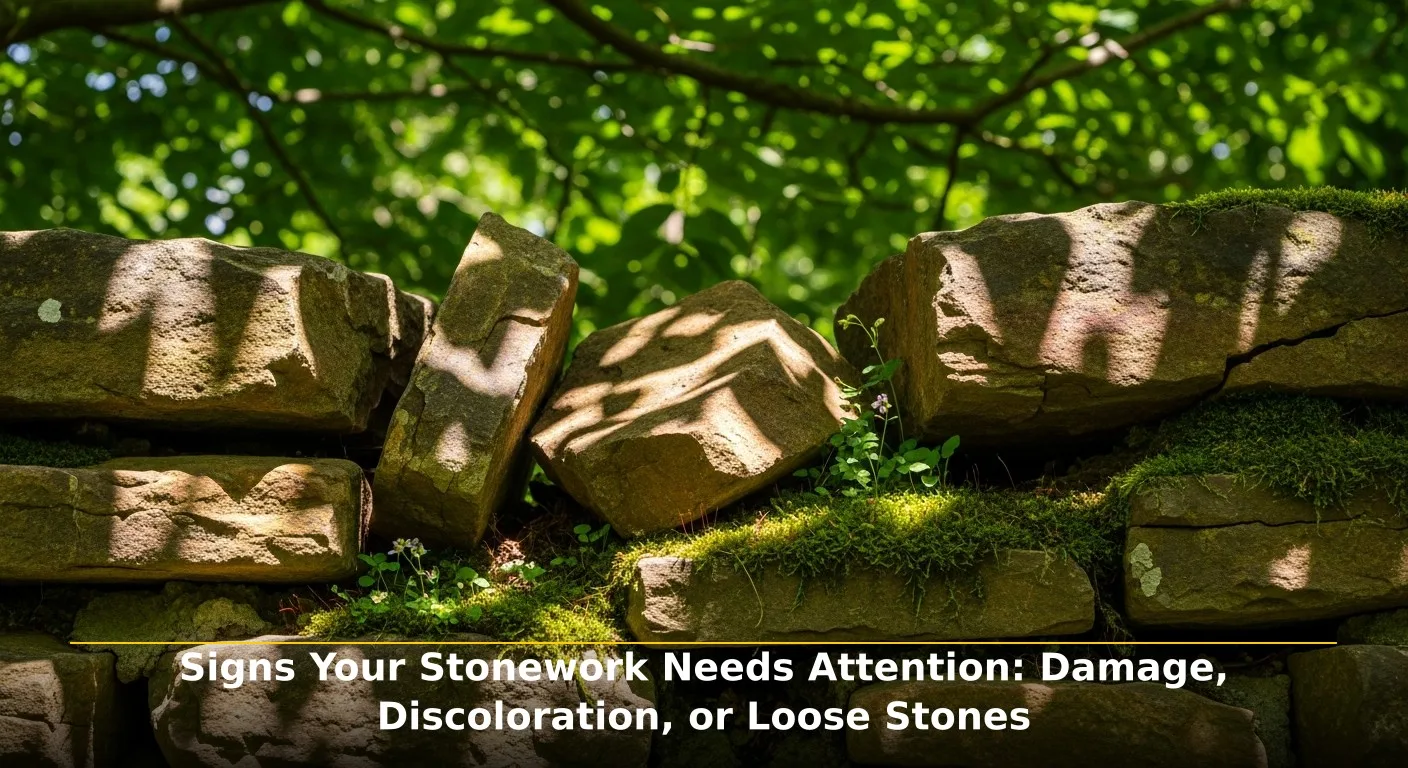
- Description: Individual stones that you can wiggle by hand or have visibly moved out of alignment with their neighbors.
- Underlying Cause: Deteriorated mortar (a process called “raveling”) has lost its bond.
- Action Required: Schedule Prompt Repair. Loose stones will lead to greater loosening and can fall out, creating a safety hazard and water-entry points.
B. Bulging or Leaning Walls
- Description: A section of wall bowing outward or a wall that is no longer plumb (vertical).
- Underlying Cause: This is a severe failure often due to water saturation, frost heave in the soil behind the wall, or a failed structural tie in a multi-wythe (multi-layer) wall.
- Action Required: IMMEDIATE PROFESSIONAL INTERVENTION. Bulging or leaning walls are at high risk of collapse. The area should be cordoned off, and a masonry expert should be contacted immediately.
3. The Stain of Moisture: Efflorescence and Water Infiltration

Discoloration is your stonework’s way of communicating a moisture problem.
A. Efflorescence
- Description: Fluffy or crystalline white, chalky deposit on the surface of the stone or mortar.
- Underlying Cause: Soluble salts within the masonry are dissolved by water. As the water migrates to the surface and evaporates, it leaves the salts behind. This isa clear sign that water is moving through your wall.
- Action Required: Identify Moisture Source. While efflorescence itself is mostly cosmetic, its persistent presence is a warning. Find and fix the source of the moisture (e.g., faulty gutters, poor drainage, lack of sealant).
B. Dark, Damp Patches or Green Growth
- Description: Persistent dark staining or the growth of moss, mildew, or algae on the stone surface.
- Underlying Cause: Constant moisture. Stone is not drying out properly, which accelerates deterioration.
- Action Required: Schedule Maintenance & Source Control. Improve drainage, clean the surface, and ensure the stone can breathe.
4. The Eroded Surface: Spalling and Mortar Deterioration

This is where the damage from moisture and freeze-thaw cycles becomes undeniably visible.
A. Spalling Stone
- Description: Surface of the stone is flaking, peeling, or chipping away, often creating a crumbly or pockmarked appearance.
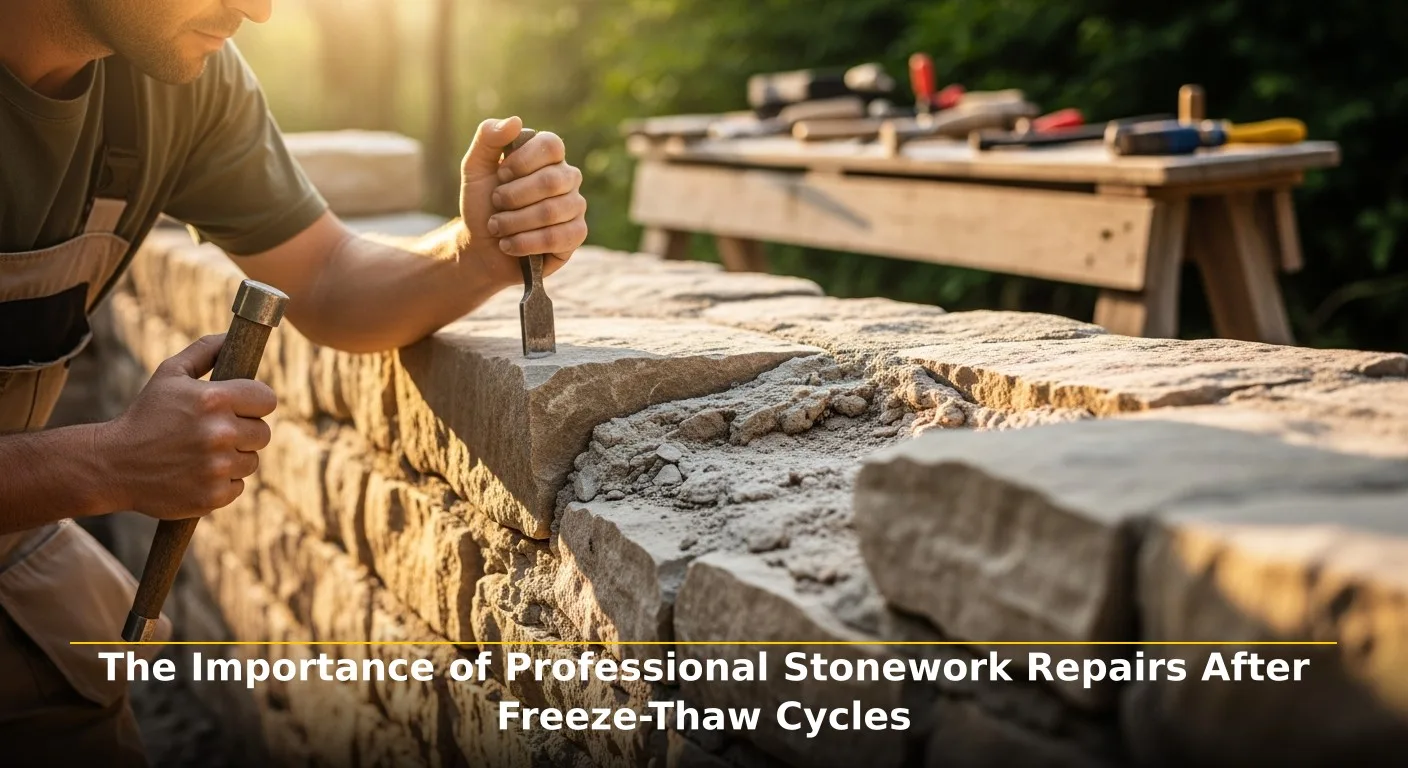
- Underlying Cause: The classic sign of freeze-thaw damage. Water trapped within the stone freezes and expands, spalling the face. It can also be caused by using a hard, non-breathable sealant that traps moisture.
- Action Required: Schedule Professional Repair. Spalling indicates advanced water damage. The affected stones are weakened and the root cause of water infiltration must be addressed.
B. Deteriorated Mortar (Weeping/Jointing)
- Description: Mortar joints that are cracked, crumbly, recessed, or missing entirely.
- Underlying Cause: Weathering and erosion from wind and water. Mortar is intentionally softerand acts as a sacrificial element. In freeze-thaw climates, it fails first.
- Action Required: Schedule Repointing. Failed mortar allows water deep into the wall system, leading to spalling, internal damage, and structural instability.
Homeowner’s Triage Guide: When to Act
Sign/Symptom | Urgency Level | Recommended Action |
Bulging or Leaning Wall | EMERGENCY | Cordon off area; call a masonry professional immediately. |
Active Water Leak | HIGH | Schedule professional diagnosis and repair within days. |
Stair-Step Cracking | HIGH | Schedule professional structural assessment within 1-2 weeks. |
Loose Stones | MEDIUM-HIGH | Schedule repair soon; temporary stabilization may be needed. |
Spalling Stone | MEDIUM | Schedule professional repair and waterproofing evaluation. |
Crumbling Mortar | MEDIUM | Plan for repointing in the next suitable season (spring/summer). |
Efflorescence | LOW-MEDIUM | Investigate moisture source; schedule cleaning and sealing. |
Hairline Cracks | LOW | Monitor during seasonal inspections. |
5. Partnering with a Professional: Ensuring Lasting Results

Once you’ve identified a problem, selecting the right mason is paramount. A qualified professional doesn’t only fix what you see; they diagnose and solve the root cause.
- Specialization: Choose a contractor who specializes in masonry and stonework, not a general handyman.
- Material Knowledge: They should be able to discuss mortar types (e.g., Type N, O, or lime-based mixes) and the importance of vapor-permeable sealants for material compatibility.
- Detailed Written Estimate: The estimate should clearly outline scope of work, including preparation, materials to be used, and a project timeline.
- Insurance and Licensing: Verify they carry both liability and workers’ compensation insurance.
Conclusion: Vigilance Preserves Value
Your stonework is a durable but dynamic part of your home. By performing regular visual inspections and understanding the language of cracks, stains, and shifts, you become the first line of defense against costly damage. Addressing issues including crumbling mortar and efflorescence with a scheduled maintenance plan prevents the onset of catastrophic failures like bulging walls and severe spalling.
When in doubt, a consultation with a qualified stone mason is a small investment that provides peace of mind and protects the significant investment you have in your home.
FAQs About Signs Your Stonework Needs Attention: Damage, Discoloration, or Loose Stones
1. Can I just fill a crack with caulk?
No. Standard silicone or acrylic caulk is not compatible with masonry. It will trap moisture and fail quickly due to UV exposure and temperature swings. Professionals use specialized mortars or masonry sealants designed for this purpose.
2. A stone fell out of my wall. Can I just mortar it back in?
You can, but for a lasting repair, the cavity must be properly cleaned, and the correct, compatible mortar mix must be used. If one stone is loose, others are often nearing failure, indicating a wider need for repointing.
3. How often should I inspect my stonework?
A thorough visual inspection should be conducted twice a year—once in the spring to assess winter damage and once in the fall to prepare for winter.
4. How much does it typically cost to repoint a stone wall? Costs vary widely based on height and deterioration, but professional repointing is a fraction of what it would be to rebuild a failed wall. While it is an investment, it guarantees the structural bond for decades.
5. What is the role of flashing in stonework maintenance?
Flashing is a thin sheet of metal or plastic material installed behind the stone facade at transition points (like window sills, the base of a chimney, or the base of the wall). Its sole purpose is to deflect penetrating water back out to the exterior of the wall system. Failed or missing flashing is a main cause of severe, hidden moisture damage that leads to freeze-thaw failure.
6. What does it mean if my stone facade is weeping?
Weeping refers to water actively running or seeping out of the wall, usually near the bottom. This is a severe red flag indicating water has bypassed the internal drainage plane of the wall and is accumulating inside. The source of the leak (often a roof, gutter, or faulty flashing) needs immediate professional diagnosis.
7. What is the purpose of intentionally making the mortar joint softer than the stone?
Mortar is designed to be the “sacrificial” element in a wall. By being slightly softer and more porous than the stone, it allows moisture to escape through the joint rather than forcing the water to freeze and expand inside, which would cause the stone to spall or crack. Using a soft, lime-rich mortar is key to masonry longevity.
8. How quickly does foundation movement cause stair-step cracks?
Foundation movement can cause stair-step cracks to appear suddenly (over a few days or weeks), or they may develop slowly over several years. If you spot a crack that is visibly widening in a short period, the movement is considered “active” and requires immediate assessment by a structural engineer before a mason can safely perform repairs.